Thursday, March 21, 2013

Current Events Reading and Exam Review: 3/22

Read the following articles in the Economist for tomorrow:

Identify terms from the review sheet that are relevant in each article. Prepare to come to class with a list of terms that is relevant to each article above. We will discuss the articles as they pertain to the upcoming Closed-book Assessment.

For extra participation points, share some of the terms you found in each article and explain how they are related to the story in the comments.

Wednesday, March 20, 2013

Review for Second Closed-book Assessment

Your second Closed-book Assessment takes place in class this Monday.

It is similar to the format of the first exam, with the caveat that you need to cite articles from the reader (maroon book) that relate to the identification term by author or title. This test is 10% of your final grade.

You may download the review sheet here. I have also scheduled a review session this Friday from 4-5 PM in Buckman 103. If you review questions but cannot make the review session, feel free to set up an appointment with me, drop by during office hours or send me an email.

Remember to bring blue exam booklets to class. If you require special accommodations, please let me know so we can make arrangements.

Friday, March 8, 2013

Online Discussion for Spring Break

I didn't find anything interesting from the Economist that I wanted to share on the blog, so I'm sharing this article about the latest threats emanating from the Democratic People's Republic of (North) Korea. From CNN:
A day after the isolated regime in Pyongyang had threatened a possible "preemptive nuclear attack" -- something analysts say they think it is unlikely and currently unable to do -- its official news agency reeled off a number of agreements with South Korea that it said would no longer apply.
One of those agreements is the ceasefire that has kept the Korean War on pause since 1953 (the two states are still technically at war).

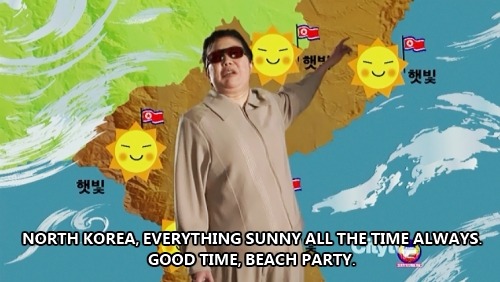
Comedienne Margaret Cho plays Kim Jong Il on NBC's 30 Rock

Clearly, Kim Jong Un is writing checks he can't cash--North Korea is far weaker than South Korea, not to mention China and the United States--but that doesn't mean he can't do a whole lot of damage.

Does that mean that Kim is being irrational? What cognitive shortcuts and psychological crutches might be leading Kim to make these threats? Might there be a benefit to such irrationality? Read the article and comment for participation points.

Friday, March 1, 2013

Midterm Course Evaluations

Today, I handed out progress reports assessing your performance in this course to date. Now, I would like you to assess my progress.

Please head to the link below and fill out the midterm course evaluation. Most of the questions are required, excepting the final free response question. It should take you five minutes, at most.

http://www.surveymonkey.com/s/3P6G7TJ

I am looking to get 75% saturation on this survey, and I won't stop bugging you until I get it.

Unlike end-of-course evaluations, these will actually help me make this class better, rather than the next one I teach. Thus, if you think you can benefit from some changes (or strongly believe things should stay the same), here is your chance to let me know--anonymously.

Thursday, February 28, 2013

Current Events Reading: 3/01

Please read and come prepared to discuss the articles in the latest edition of the Economist.

Note: Friday's class will be a bit different than previous current event discussions. It will be closer to our usual lecture-cum-discussion style, and it will incorporate the readings you were assigned on Wednesday.

Be prepared to discuss how the following stories relate to the challenges to sovereignty and the "wars of globalization" discussed in the previous class' readings:

Monday, February 18, 2013

UAE Helping Joplin Rebuild, Transform

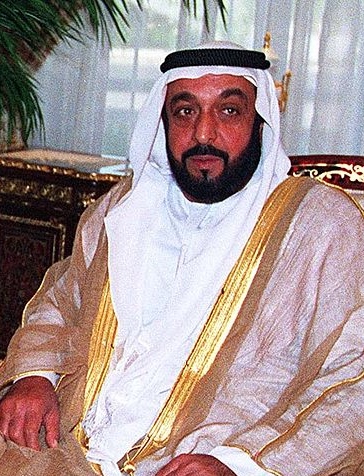
UAE President
Khalifa Bin Zayed Al Nahyan
Photo credit: Wikipedia
According to a recent article in the Washington Post, Joplin, MO is recovering from the devastation of the May 2011 tornado with help from an unlikely source--the United Arab Emirates.

The UAE is spending millions to help the Joplin School District "think big," funding such initiatives as replacing the books (lost in the twister) with MacBooks. While Joplin received millions from the US government for disaster recovery, this is nevertheless an example of a shift in foreign aid disbursement.

From WaPo:
Motivated by the same principal reasons that the U.S. government distributes foreign assistance — to help those less fortunate and to influence perceptions among the recipients — the handouts mark a small but remarkable shift in global economic power.
How does what's happening in Joplin reflect a shift in global power, and what types of power are involved? Is it a good thing that Joplin is taking money from the UAE to recover?

Read the article and share your (reasoned) thoughts in the comments for participation credit.

Wednesday, February 13, 2013